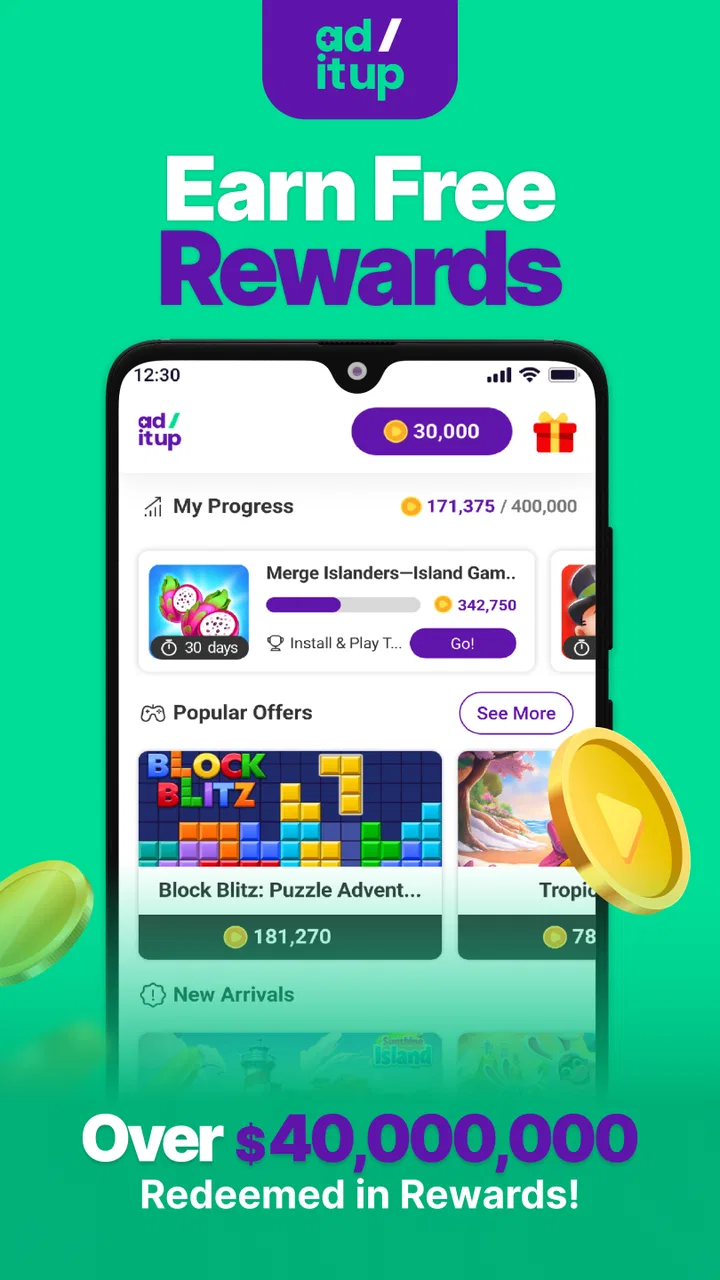
Ad It Up—Save on Your Bills
- 4.7
- Rating
- 1.00M
- Installs
- Free
- Price

 Analysis by App-foxy
I approached Ad It Up—Save on Your Bills as a shopping app with a very specific promise: instead of treating my phone bill as a fixed expense, it gives me a way to work toward wireless bill credit through everyday mobile activity. That makes it different from a normal marketplace, coupon app, or cash-back service. The important question is not simply whether it is free, but whether its reward style fits the way I already use my phone.
Developed by Play2Pay, Inc., this free app is aimed at people who are comfortable exchanging some attention and time for savings. Its store short description is “Ad It Up,” while the longer summary focuses on earning wireless bill credit through games and more. I would describe it as a small rewards routine rather than a replacement for shopping around on a bill or changing phone plans.
The app has been available since July 10, 2019, and its current version is 3.55.00. It is listed for users aged Everyone, with a minimum operating system requirement of 11. That last point matters before installing: an older phone may be excluded even though the app itself is free. The service has passed the half-million-install mark and holds a 4.7 average from roughly forty-three thousand ratings, with about nineteen thousand written reviews. Those figures suggest that the concept is easy for many people to understand, although they do not remove the need to decide whether the time trade-off suits me.
You May Also Like

 Blood Strike: 2.5 Anniversary
Blood Strike’s Loadouts Turn Every Drop Into a Tactical Gamble
A close look at Blood Strike’s custom loadouts: how fast access to signature weapons reshapes its battle royale rhythm, rewards preparation, and narrows the gap between fights.

 Pandora - Music & Podcasts
Pandora’s Music Is Easy to Start, but Harder to Recover
Pandora’s strength is its low-effort path from a seed to a station. Its weak spot is how much confidence it asks you to place in connection, setup, and quiet recovery.

 8 Ball Pool
 Is Built on Rivalries, Rematches, and Routine
A close look at the rivalries, rematches, shared routines, and unanswered safety questions that turn a quick pool match into a persistent mobile community.

 Samsung Music
’s Quiet Strength Is Playing What You Already Own
Its reach comes less from spectacle than from dependable access to a personal library. That simplicity is both the app’s strongest retention engine and its ceiling.

 AccuWeather: Weather Radar
AccuWeather Review: A Quick, Clear Forecast for Everyday Decisions
For everyday plans, the best forecast is the one you can understand quickly. AccuWeather makes rain timing, radar, and local conditions easy to act on, with a few trade-offs.

 Hill Climb Racing
Why Hill Climb Racing Still Turns Crashes Into One More Run
A tiny car, a bumpy hill and one more upgrade: Hill Climb Racing keeps resurfacing because its simple chaos makes every near-miss feel personal.
More From Our News Desk



How I Decided Whether Ad It Up Was Worth Using
I judge Ad It Up by more than the appeal of its first few sessions: I want to know whether earning wireless bill credit can settle into a routine without taking over my spare time. I’ll look at what makes the format inviting at the start, then weigh that against the habits and upkeep it asks of me. That balance is what determines whether it deserves lasting space on my phone.
The real exchange is attention for a smaller bill
My first decision criterion is simple: what am I giving up to earn the benefit? With this app, the cost is not an upfront purchase. It is attention, mobile time, and the willingness to interact with the activities presented in the app. That can feel painless when I am already looking for something casual to do, but it becomes less attractive if I have to force myself to open the app repeatedly just to keep the process moving.
This is why I would not compare it directly with a traditional shopping app. A shopping service helps me find or buy something. A coupon app reduces the price of a planned purchase. A cash-back service usually connects the reward to spending I intended to make anyway. Ad It Up belongs to another category: it turns selected mobile engagement into progress toward wireless savings. The reward is more relevant to someone who wants help with a recurring bill than to someone seeking the lowest price on a particular product.
I also look at how predictable the benefit feels. A phone bill is a real, recurring expense, so the idea of applying credit to it is more useful to me than collecting a vague balance for a future purchase. At the same time, I would not budget around the app as though it were income. The sensible approach is to treat any credit as a bonus that may soften the bill, not as a guaranteed way to cover it.
Who gets the most value from the format
I think the best fit is someone who already plays casual mobile games, enjoys trying different activities, or regularly has spare moments during commutes and breaks. For that person, the app can make otherwise unstructured screen time feel more purposeful. It is especially appealing when the desired outcome is practical: reducing a wireless expense rather than receiving another shopping voucher.
It can also suit households where one person manages the phone bill but another person spends time on the device. In that situation, the app creates a clear reason to use the rewards channel, provided everyone understands how the credit works and who ultimately benefits. I would still keep expectations realistic. A few short sessions may feel worthwhile, while long sessions undertaken only for rewards can make the exchange look much less favorable.
I would be more cautious if I dislike advertising, have very limited data or battery capacity, or want a completely passive rewards tool. The app’s premise involves active participation, so it is not the right choice for someone who wants savings to happen quietly in the background. It may also be a poor match for a person who tends to download every suggested game or activity without checking whether the time spent is actually enjoyable.
Where it stands out from ordinary shopping rewards
The strongest distinction is the destination of the reward. Many shopping-oriented services make me wait until I have a suitable purchase, a redeemable balance, or a reason to return to a particular store. Here, the motivation is tied to wireless service, which is an expense many people already pay every month. That gives the reward a clearer purpose than a discount I might forget to use.
Another advantage is flexibility of mood. I do not have to be actively shopping to find a reason to open it. If I have a few spare minutes and want a casual activity, the app can fit that moment. This makes it more naturally connected to leisure than standard coupon tools, while still pointing toward a practical household saving.
There is also a psychological benefit in seeing a small recurring cost as something I can influence. That does not make the bill disappear, but it can make the reward feel more tangible than points attached to an occasional purchase. For me, that clarity is the app’s main strength: the purpose is easier to understand than a generic points balance.
Three habits that make the experience more sensible
My first useful habit would be to set a time boundary before opening the app. I would decide whether I have five minutes, fifteen minutes, or a longer free period, then stop when that window ends. This prevents the reward goal from quietly turning into an unlimited scrolling session. The app works better as a planned side activity than as something I leave running whenever I pick up my phone.
Second, I would separate “something I want to do” from “something I am tolerating for credit.” If an activity is enjoyable, it has two kinds of value: entertainment and progress toward the bill. If it is frustrating, the credit has to compensate for both the lost time and the irritation. That simple test helps me avoid chasing every available option just because it is displayed.
Third, I would check the reward progress before assuming that a session was worthwhile. A practical workflow is to open the app, identify the current path toward credit, choose one activity, and review the result afterward. That makes it easier to notice whether I am actually moving toward the intended benefit instead of merely spending time inside the app. It also gives me a clearer basis for deciding whether to continue tomorrow.
A realistic everyday scenario
Imagine that I am waiting for an appointment and already expect to use my phone for a while. I could browse a shopping feed without buying anything, or I could open Ad It Up and choose an activity that genuinely interests me. If I finish the session and see progress toward wireless bill credit, the time has produced a more concrete outcome than idle browsing.
The same situation can work during a short evening break, but only if I avoid turning it into a second job. I would not open the app while rushing, driving, studying, or handling anything that needs concentration. The best use is a low-pressure window where I am willing to engage, and where the activity itself is acceptable even if the reward arrives gradually.
What can make the experience less attractive
The main friction is that the reward is not free in the everyday sense. There is no purchase price, but there is a time price. People who value uninterrupted phone use may find the advertising and activity-based model distracting. Someone who already has a preferred game library may also resent switching between activities for a benefit that feels too small compared with the time invested.
I would also avoid treating the high average rating as a promise that every user will have the same experience. Ratings tell me that many people like the concept, but personal value depends on the wireless credit arrangement, the activities available to me, and my tolerance for reward-oriented engagement. The app can be well received and still be wrong for a person who wants direct cash, shopping discounts, or completely passive savings.
When another category is a better fit
If my goal is to save on groceries or household purchases, a coupon or cash-back shopping app is usually more direct. I can connect the reward to something I was going to buy, rather than spending time on mobile activities first. If I want a lower monthly phone bill immediately, comparing plans, reviewing usage, or negotiating with a provider may have a larger effect than any rewards routine.
If I want entertainment above all else, a normal game without a reward layer may be better. I can choose it for quality, story, controls, or social play instead of considering whether each session contributes to a bill credit. On the other hand, if I already enjoy casual mobile activity and want that time to have a practical side effect, Ad It Up has a clearer reason to exist.
For people who prefer direct monetary rewards, a cash-back service may feel easier to understand. The trade-off is that cash-back platforms often depend on shopping behavior, while this app is built around mobile engagement. Neither approach is universally superior; the right choice depends on whether I would rather earn while buying something or while using my phone for leisure.
What I would check before committing
Before making it part of my routine, I would confirm that my device meets the minimum operating system requirement of 11 and that the wireless credit option is relevant to my situation. I would also make sure I understand where the credit is intended to go, rather than assuming it can be converted into any reward I choose. That small check prevents disappointment later.
I would begin with a short trial rather than immediately planning around the app. After several sessions, I would ask myself three practical questions: Did I enjoy the activities without the reward? Did the progress feel understandable? Did the expected bill benefit justify the time? If the answer is no to two of those questions, I would switch back to a more direct savings method.
Another useful boundary is to keep the app separate from essential phone tasks. I would not allow the pursuit of credit to interfere with work, school, sleep, or communication. The app is easiest to live with when it occupies a defined leisure slot. That keeps the reward from becoming an invisible drain on attention.
My recommendation for different kinds of users
I recommend Ad It Up—Save on Your Bills to people who enjoy casual mobile activities and would genuinely appreciate wireless bill credit. It is free to try, its purpose is easy to grasp, and its shopping category is unusual enough to offer something that ordinary deal-finding apps do not. The Everyone age rating also makes its positioning broad, though each user should still decide whether the engagement style is comfortable.
I would skip it if I want guaranteed savings, instant cash, or a totally passive service. I would also choose a conventional shopping rewards app if most of my savings opportunities come from planned purchases. The important trade-off is not hidden: this app asks for participation in exchange for progress toward a specific type of credit.
My final view is cautiously positive. Play2Pay, Inc. has built an app with a practical destination for its rewards, and the strong user response indicates that the model works well for many people. I would use it as an occasional, time-limited way to make spare mobile minutes more useful, never as the foundation of my household budget. The best reason to install it is not the promise of effortless savings, but the chance to turn leisure I already planned to spend into a modest reduction in a bill I already have.
FAQs for Ad It Up—Save on Your Bills
01What features does Ad It Up offer to help me save on my bills?
Ad It Up provides a comprehensive suite of features designed to help users manage and reduce their bills effectively. The app includes bill tracking, personalized saving tips, expense categorization, and reminders for due dates. Additionally, it offers insights into spending patterns and potential areas for savings, making it a valuable tool for budget-conscious users.
02Is Ad It Up compatible with both Android and iOS devices?
Yes, Ad It Up is available for download on both Android and iOS platforms. The app is designed to work seamlessly across different devices, ensuring a consistent user experience whether you are using a smartphone or tablet. Users can download it from the Google Play Store or the Apple App Store.
03Does Ad It Up require access to my financial information?
To provide accurate bill tracking and saving suggestions, Ad It Up requires access to certain financial information. However, the app prioritizes user privacy and security, using encryption to protect your data. Users can choose which accounts to link and have control over the information they share, ensuring a secure experience.
04How does Ad It Up help in reducing monthly expenses?
Ad It Up assists in reducing monthly expenses by offering personalized insights and recommendations based on your spending habits. It identifies unnecessary expenditures, suggests cheaper alternatives, and provides exclusive deals and discounts. The app's goal is to empower users to make informed decisions that lead to significant savings over time.
05Are there any costs associated with using Ad It Up?
Ad It Up offers a free version with essential features to help users save on their bills. For those seeking enhanced functionalities, such as advanced analytics and additional savings tools, there is a premium subscription available. The app ensures transparency in its pricing and provides value for both free and premium users.
Pros
- User-friendly interface for easy navigation.
- Customizable alerts for bill payment reminders.
- Offers personalized saving tips and advice.
- Syncs with multiple bank accounts seamlessly.
- Secure encryption ensures data privacy.
Cons
- Limited support for international currencies.
- Occasional glitches with account syncing.
- In-app ads can be intrusive at times.
- Some features locked behind a paywall.
- No offline mode for managing data.

Ad It Up—Save on Your Bills
Gallery